

Jewish Quarter (Josefov) Seen from the River
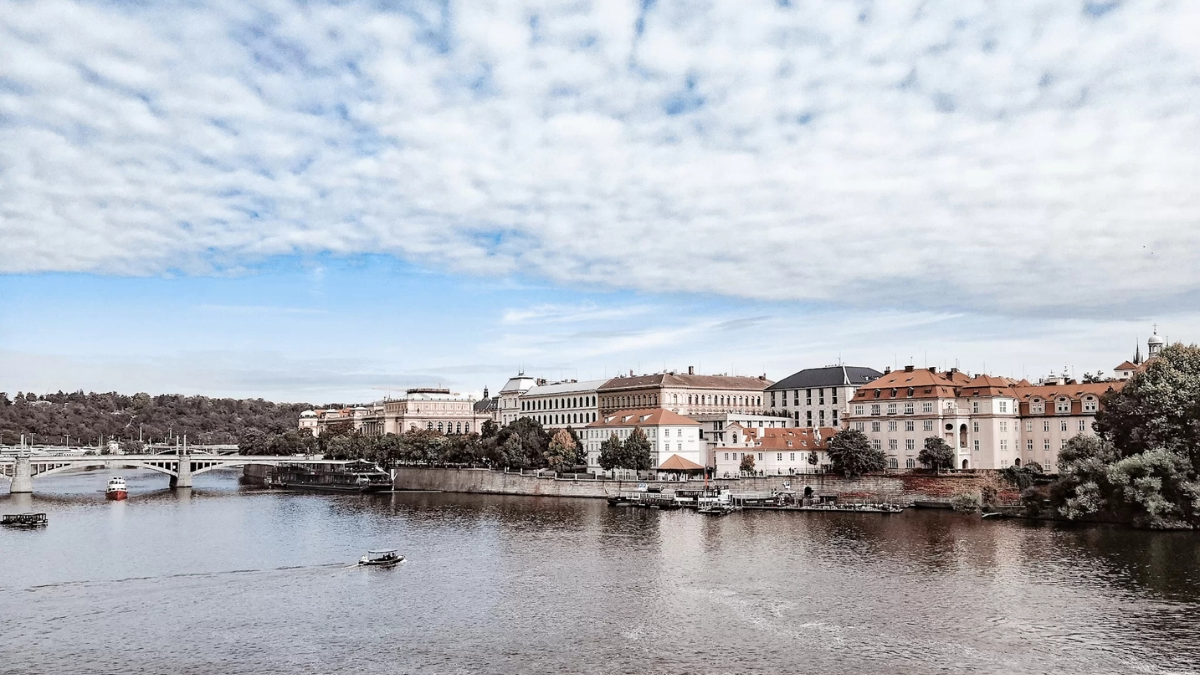
The Jewish Quarter (Josefov) is visible from the Vltava River on the right bank, between Čech Bridge and Charles Bridge. From the river, you see the Art Nouveau apartment facades of Pařížská Street and the surrounding streets — built between 1893 and 1913 on the demolished remains of the medieval ghetto — along with the rooflines of the surviving synagogues and the Jewish Town Hall. The Old-New Synagogue, dating from around 1270 and the oldest functioning synagogue in Europe, is visible just behind the first row of buildings. The Jewish Quarter has been part of Prague’s UNESCO World Heritage Site since 1992.
From the river, Prague’s Jewish Quarter presents an elegant, affluent face — the wide boulevard of Pařížská Street lined with grand Art Nouveau apartment buildings, their ornate facades reflecting the early 20th-century wealth of the neighbourhood that replaced the demolished medieval ghetto. What the riverfront view does not immediately reveal is what lies just behind it: six surviving synagogues, the Old Jewish Cemetery with tombstones dating to 1439, a ceremonial hall, and one of the most significant collections of Jewish cultural heritage in Central Europe.
What You See from the River
From a Prague river cruise, the Jewish Quarter appears on the right bank between Čech Bridge and Charles Bridge — a continuous sequence of late 19th and early 20th-century Art Nouveau apartment buildings along the embankment and the Pařížská Street boulevard behind. The Jewish Town Hall tower is visible above the roofline; the twin-gabled roof of the Old-New Synagogue can be seen from certain angles further inland.
The riverfront view of Josefov is primarily the view of what replaced the medieval ghetto — the wide, Haussmann-influenced boulevards and Art Nouveau apartment blocks built between 1893 and 1913 during the so-called “Prague Clearance” (asanace). This reconstruction demolished most of the original ghetto, which had grown increasingly overcrowded and unsanitary. Six synagogues, the Jewish Town Hall, and the Old Jewish Cemetery were preserved; everything else was replaced.
The surviving structures are set slightly back from the river — a few minutes’ walk from the embankment. On the cruise, the most visible element is the boulevard of Pařížská (Paris Street), Prague’s most expensive shopping street, which runs from the Old Town Square directly toward the riverfront. From the water, the tree-lined boulevard is framed by the buildings on both sides and leads the eye from the river into the heart of the city.
History: A Thousand Years on the Vltava
Jewish people have been documented living in Prague since the 10th century, arriving from Byzantine territories as merchants along trade routes that crossed the Vltava ford at the location of the present Mánes Bridge. By the 13th century, they were concentrated in a defined ghetto area between the Old Town Square and the river — the site of today’s Josefov.
The history of Prague’s Jewish community spans eleven centuries and encompasses both extraordinary intellectual and cultural flourishing and devastating persecution. The community produced some of the most significant Jewish scholars of the medieval and early modern periods, including Rabbi Loew (Maharal), who became associated with the legend of the Golem — a clay figure said to have been created from clay taken from the Vltava riverbank to protect the community from attack.
The ghetto was formally established in the 13th century, when Jewish residents were ordered to concentrate in this area. It was renamed Josefov in 1850 in honour of Emperor Joseph II, who had issued an Edict of Tolerance in 1781 that granted Jews significantly expanded rights. During the Holocaust, virtually the entire remaining Jewish population of Prague was deported and murdered. Most of the community’s cultural heritage survived only because the Nazis had planned to create a “museum of an extinct race” — inadvertently preserving the artefacts they intended to display.
The Surviving Sites
The Jewish Quarter today preserves six synagogues, the Old Jewish Cemetery, the Jewish Town Hall, and the Jewish Museum. The Old-New Synagogue, built around 1270, is the oldest functioning synagogue in Europe and the most significant single structure in Josefov. The Old Jewish Cemetery contains approximately 12,000 visible tombstones, with estimates of up to 100,000 burials in layers below.
The Old-New Synagogue (Staronová synagoga) — Built c.1270 in a unique Czech-Gothic style with twin naves and a distinctive saddle roof with late-Gothic brick gables. It is the oldest functioning synagogue in Europe and still holds regular services. Because the ghetto’s terrain was raised by about two metres during the 19th-century reconstruction, the synagogue now sits below street level — a subtle reminder of the original topography.
The Old Jewish Cemetery (Starý židovský hřbitov) — The most remarkable Jewish cemetery in Europe. Active from 1439 until 1787, it contains approximately 12,000 visible tombstones in 12 layers — when the cemetery ran out of space, new soil was brought in and burials continued on top of previous ones. The oldest surviving tombstone belongs to the scholar Avigdor Kara (d. 1439).
The Pinkas Synagogue — Built in 1535 and now serving as a Holocaust memorial. The interior walls are inscribed with the names of 77,297 Bohemian and Moravian Jewish victims of the Shoah — one of the most powerful memorial installations in Europe.
The Spanish Synagogue — Built in 1868 in the Moorish Revival style, with an extraordinary gilded interior of geometric patterns inspired by the Alhambra in Granada. The most visually spectacular interior of any Prague synagogue.
The Maisel Synagogue — Built in the 16th century, now housing a permanent exhibition on the history of Czech Jews from the 10th to the 18th century.
From River to Street: Getting to Josefov
The Jewish Quarter is an easy walk from any of the embankment cruise piers. From Čech Bridge, Pařížská Street runs directly south toward Old Town Square — the Jewish Quarter occupies the streets to the left (east) of Pařížská.
Opening hours: Synagogues and the Old Jewish Cemetery open Sun–Fri (closed Sat and Jewish holidays). Typical hours 9:00–18:00 (summer), 9:00–16:30 (winter).
Tickets: A combined Jewish Museum ticket covers the Old Jewish Cemetery and most synagogues (except the Old-New Synagogue, which requires a separate ticket). Available at the ticket offices in the quarter.
Note: The Jewish Quarter is adjacent to some of Prague’s most expensive shopping and dining — Pařížská Street hosts Louis Vuitton, Hermès, and comparable brands alongside kosher restaurants. The contrast between the memorial sites and the luxury boulevard is one of the more striking features of the modern neighbourhood.
Buy This TicketThe Jewish Quarter and the Vltava
The connection between Josefov and the Vltava is not merely geographic. The river has been central to the quarter’s history from the beginning — the original Jewish settlement formed near the main Vltava ford; the Golem legend ties the community’s most famous myth directly to the river’s clay banks; and the 19th-century reconstruction deliberately oriented the new neighbourhood’s main boulevard toward the embankment, creating the Pařížská axis that connects river to square.
From the cruise, this history is visible in miniature: the broad embankment facade of Art Nouveau apartments, the boulevard leading inland, the glimpsed rooflines of the synagogues behind, and the water of the Vltava that has been flowing past this community for a thousand years.
For the full cruise route landmark overview, see Landmarks You'll See on a Prague River Cruise.
Frequently Asked Questions
Is the Jewish Quarter visible from a Prague river cruise?
Yes — the right bank between Čech Bridge and Charles Bridge shows the Art Nouveau facades of Pařížská Street and the surrounding district. The synagogue rooflines and Jewish Town Hall tower are visible from certain cruise positions. The full quarter, including the Old Jewish Cemetery, is a short walk from the embankment.
What is the most significant historic site in Josefov?
The Old-New Synagogue (Staronová synagoga), built around 1270 — the oldest functioning synagogue in Europe. It still holds regular services and is located slightly below current street level, a legacy of the original ghetto topography.
Is the Old Jewish Cemetery still in use?
No — the cemetery was closed to new burials in 1787. It contains approximately 12,000 visible tombstones in up to 12 burial layers, with estimates of up to 100,000 burials in total beneath the current surface. It is one of the most significant Jewish cemeteries in the world and is open to visitors as part of the Jewish Museum complex.
Why did the medieval ghetto disappear?
The original medieval ghetto was demolished between 1893 and 1913 in a programme called the “Prague Clearance” (asanace), officially justified by sanitary concerns. It was replaced by the Art Nouveau apartment buildings visible from the river today. Six synagogues, the Jewish Town Hall, and the cemetery were preserved; everything else was razed.
How do I visit Josefov from the cruise departure area?
From the Čech Bridge pier area, walk south along Pařížská Street (the wide boulevard you can see from the river) for approximately 5 minutes to reach the Jewish Museum ticket offices and the Old-New Synagogue. The quarter is open Sunday–Friday; closed Saturday and Jewish holidays.
