

Amsterdam to Prague River Cruise: What You Need to Know
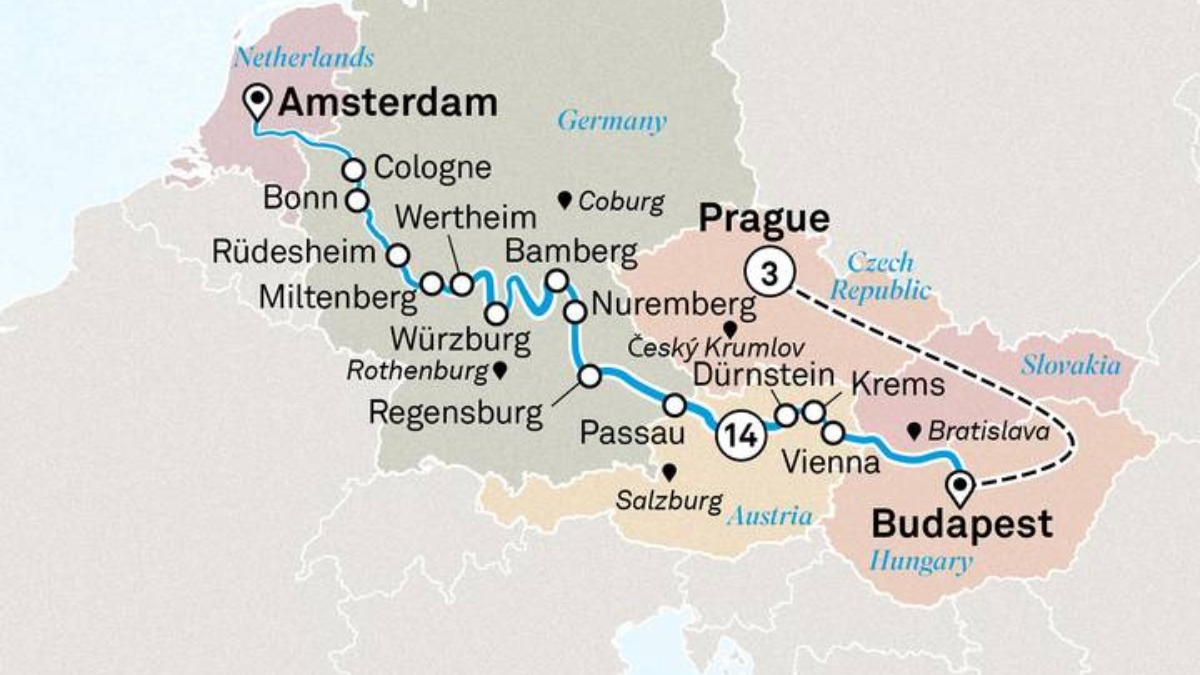
There is no direct river cruise from Amsterdam to Prague. The two cities are not connected by navigable waterways. What is commonly called an “Amsterdam to Prague river cruise” is an 18-day European river cruise along the Rhine, Main, and Danube rivers, ending in Budapest — followed by a coach transfer of approximately 525 km to Prague for a 2–3 night land extension. Operators offering this itinerary include Emerald Cruises, Scenic, Travelmarvel, CroisiEurope (via the Elbe, which routes through Prague differently), and several others. Prague is one of the most popular end-of-cruise destinations in Central Europe.
If you have searched for “Amsterdam to Prague river cruise” and arrived here, this guide will give you the full and accurate picture. The search query is enormously popular — but what it describes is more complex than the name suggests, and understanding the actual structure of these itineraries before you book saves significant confusion.
Why There Is No Direct River Route
Amsterdam and Prague are not connected by navigable waterways. The Rhine, which flows through Amsterdam, connects to the Main and Danube via the Main-Danube Canal — but the Danube flows to Budapest, not Prague. Prague sits on the Vltava and Elbe (Labe) river system, which connects to Germany and the North Sea via a separate northern route. The two systems do not meet in a way that creates a through route from Amsterdam to Prague.
The geography is worth understanding clearly. The Rhine-Main-Danube route — the most popular Central European river cruise corridor — runs east-west across Central Europe, from Amsterdam through Germany, Austria, Slovakia, and Hungary. It reaches Budapest but not Prague. Prague lies north of this corridor, on the Vltava River, which flows north into the Elbe (Labe) and eventually to the North Sea via Germany.
To reach Prague by river from Amsterdam, you would need to travel the Elbe route — which runs from Hamburg or Berlin through eastern Germany and into Bohemia. This is a genuinely different itinerary and is offered by only two operators: Viking and CroisiEurope. The Elbe is also known as the most frequently modified or cancelled river cruise in Europe, due to unpredictable low-water conditions that regularly prevent full river navigation.
The Rhine-Main-Danube Route: Amsterdam to Budapest (with Prague Extension)
The standard “Amsterdam to Prague river cruise” is an 18-day itinerary along the Rhine, Main, and Danube rivers, ending in Budapest. From Budapest, a coach transfer of approximately 525 km (around 5 hours) takes passengers to Prague for a 2–3 night land extension before the trip concludes. The river portion covers approximately 1,200–1,440 km through five or six countries.
This is the itinerary most travellers encounter when searching for Amsterdam to Prague river cruises. It is an impressive journey — covering the Rhine Gorge with its 40 castles, Cologne Cathedral, the Baroque palace of Würzburg, the Wachau Valley vineyards in Austria, Vienna, Bratislava, and Budapest — before the Prague extension adds Czech Republic to the route.
Key cities on the standard Rhine-Main-Danube itinerary include: – Amsterdam (embarkation) – Cologne — Gothic cathedral, one of the largest in Northern Europe – Bamberg — UNESCO World Heritage medieval city – Nuremberg — historic old town, significant WWII history – Würzburg — Baroque Residence palace – Regensburg — medieval centre, UNESCO listed – Vienna — Habsburg imperial capital, classical music, Schönbrunn Palace – Bratislava — compact Slovak capital, hilltop castle – Budapest — Chain Bridge, Parliament, Castle Hill – Prague (coach extension, 2–3 nights) — Charles Bridge, Prague Castle, Old Town
The Main-Danube Canal, which connects the two river systems at the heart of the route, involves passage through 16 locks. Watching the boat navigate the lock system is one of the more memorable practical experiences of the journey.
The Elbe Route: A Different Prague River Cruise
The alternative for passengers who want Prague on a river (rather than as a coach extension) is the Elbe route, operated by Viking and CroisiEurope. The Elbe flows through the Czech Republic — the Vltava joins the Elbe (Labe) north of Prague at Mělník — and some itineraries include Prague itself as a river stop, though the navigable section of the Vltava within Prague is short and the boat typically moors at the downstream embankment.
The Elbe route is genuinely different in character from the Rhine-Main-Danube. It is less well-known, passes through less-visited eastern German cities (Dresden, Magdeburg, Wittenberg), and has a more exploratory quality. The trade-off, as noted, is navigability — low water levels on the Elbe regularly require itinerary modifications, and reviewers consistently note that the Elbe is the most unpredictable river cruise in Europe. If you choose this route, travel insurance that covers itinerary changes is worth considering.
CroisiEurope operates an itinerary from Prague to Amsterdam via Berlin on the Elbe and Havel, covering cities including Prague, Dresden, Meissen, Wittenberg, Magdeburg, Potsdam, and Berlin before continuing to Amsterdam. The primary onboard language is French.
What to Expect in Prague on a River Cruise Extension
Whether arriving by coach from Budapest or by river on an Elbe itinerary, Prague typically features 2–3 nights in the city with guided tours covering Prague Castle, Charles Bridge, and the Old Town. Most cruise operators include a guided city tour; additional free time allows independent exploration.
For passengers arriving in Prague as the final destination of an 18-day journey, the city’s concentration of UNESCO-listed architecture, walkable old town, and distinctive river setting is a strong conclusion. The Vltava River itself — and the Prague river cruise experience on it — is worth experiencing as a standalone activity during the free time in the city, even after 18 days of river cruising.
A 50-minute sightseeing cruise on the Vltava gives you the Prague skyline from the water in a format that the larger Rhine-Danube vessels cannot replicate — intimate, close to Charles Bridge, and with the castle visible throughout the entire route. See Evening Sightseeing Prague River Cruise for the most popular option.
Buy This TicketMain Operators for Amsterdam to Prague Itineraries
The 18-day Rhine-Main-Danube route connecting Amsterdam to Prague is offered by several operators including Emerald Cruises, Scenic, and Travelmarvel. Additional operators include Viking (Rhine-Main-Danube), AmaWaterways, Avalon Waterways, and Gate 1 Travel. For the Elbe route specifically, CroisiEurope and Viking are the primary options.
When comparing operators, key considerations include: – All-inclusive vs à la carte pricing — some operators include shore excursions, beverages, and Wi-Fi; others charge separately – Ship size and style — smaller ships (100–150 passengers) offer more intimacy; larger ships have more amenities – Language of operations — most operators are primarily English-speaking; CroisiEurope is primarily French – Cancellation and modification policies — particularly relevant for the Elbe route
Prague River Cruise During Your Stay
Once in Prague — whether you arrive as part of a multi-week European cruise or independently — the city’s river offers its own cruise experience on the Vltava. Unlike the large Rhine-Danube vessels, the Prague river cruises are short, affordable, and deeply embedded in the city’s tourist infrastructure.
The key difference is scale and access. The Vltava cruise boats pass directly under Charles Bridge, enter the narrow Čertovka canal, and provide views of Prague Castle from river level — none of which are possible from the large cruise vessels that dock at the city’s downstream embankments.
For the full guide to what is available on the Vltava, see the Tickets & Tours section of this site.
Frequently Asked Questions
Is there a direct river cruise from Amsterdam to Prague?
No. Amsterdam and Prague are not connected by navigable waterways. What is marketed as an “Amsterdam to Prague river cruise” is an 18-day Rhine-Main-Danube cruise ending in Budapest, followed by a coach transfer of approximately 525 km to Prague. There is no continuous river route between the two cities.
Which cruise operators offer Amsterdam to Prague river cruise itineraries?
Operators including Emerald Cruises, Scenic, Travelmarvel, Viking, AmaWaterways, and Avalon Waterways all offer Rhine-Main-Danube itineraries with Prague as a land extension from Budapest. For the Elbe route (which genuinely reaches Prague by river), CroisiEurope and Viking are the primary operators.
Can you reach Prague by river from Germany?
Yes — via the Elbe (Labe) route, which connects Hamburg or Berlin through eastern Germany into Bohemia. The Vltava joins the Elbe at Mělník, approximately 30 km north of Prague. The Elbe route is operated by Viking and CroisiEurope, though it is known as the most frequently modified European river cruise due to unpredictable low water conditions.
How long is the coach transfer from Budapest to Prague?
Approximately 5 hours (525 km). Most Rhine-Main-Danube cruise itineraries include this as an organised coach transfer on the final day, with 2–3 nights in Prague included in the total package.
What should I do on the Vltava once I arrive in Prague?
A short sightseeing cruise on the Vltava gives you the Prague river perspective that the large Rhine-Danube vessels cannot provide — passing directly under Charles Bridge, seeing Prague Castle from river level, and accessing the Čertovka canal on some routes. See the Tickets & Tours section for all available options.
