

Landmarks You'll See on a Prague River Cruise
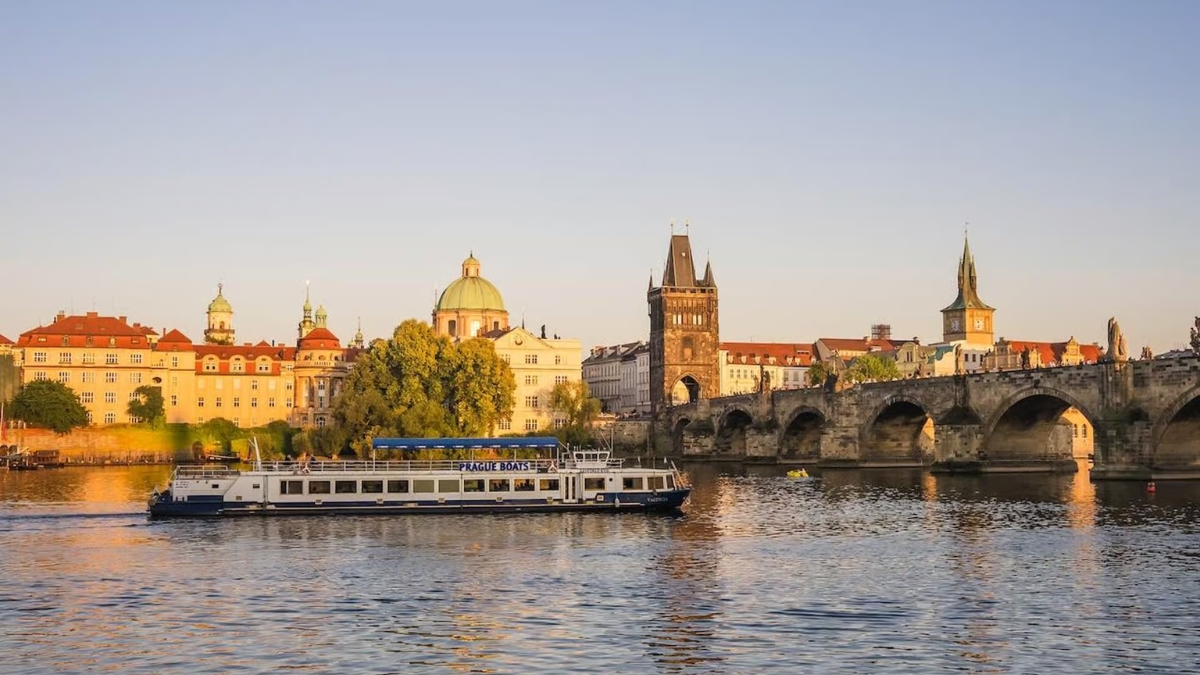
A standard Prague river cruise passes Charles Bridge, Prague Castle, the National Theatre, the Dancing House, the Rudolfinum, Kampa Island, the Jewish Quarter (Josefov), Vyšehrad, and Petřín Hill. Canal boat tours additionally enter the Čertovka — the narrow medieval waterway with the Grand Priory Mill. Longer routes (2+ hours) also reach the Smíchov lock and the Podolí Waterworks. All of these are on or directly visible from the Vltava; nothing is more than 200 metres from the riverbank on any standard route.
Prague’s Vltava riverbank is one of the most architecturally rich in Europe. The city was built on and around the river over eleven centuries, and the cumulative effect — Gothic towers, baroque embankments, Renaissance palaces, 19th-century national institutions, and 20th-century modernist landmarks — is a panoramic sequence that rewards slow attention. This guide covers every major landmark visible from a Prague river cruise, what you are looking at, and why it matters.
Charles Bridge (Karlův most)
Charles Bridge is a medieval stone arch bridge spanning 516 metres across the Vltava, built between 1357 and the early 15th century under King Charles IV. It served as the only river crossing in Prague for nearly 500 years and is lined with 30 baroque statues of saints added in the 17th and 18th centuries. From the river, you see the full length of the bridge, the two Gothic bridge towers, and the statues’ silhouettes along the parapet — a perspective impossible from the bridge itself.
Construction of Charles Bridge began in 1357 and was completed in the early 15th century, replacing the older Judith Bridge which had been severely damaged by a flood in 1342. The first stone was laid on 9 July 1357 at 5:31 AM — a date and time chosen by King Charles IV for its palindromic numerical symmetry (1357-9-7-5-3-1), reflecting his superstitious nature and belief in the significance of numbers.
Seen from beneath the bridge arches, the view upward reveals the stone piers, the sweep of each arch, and the towers at both ends. Seen from further downstream, the full 516-metre length of the bridge is visible — something you can never see while walking across it. The baroque statues, added over more than a century, represent the Counter-Reformation saints endorsed by the Habsburg rulers; the most famous is the gilded figure of St. John of Nepomuk, thrown into the Vltava from this bridge in 1393 on the orders of King Wenceslas IV.
For the full story, see Charles Bridge: History & What to Expect.
Buy This TicketPrague Castle (Pražský hrad)
Prague Castle is the largest ancient castle complex in the world by area — approximately 70,000 square metres across the Hradčany ridge above the Vltava’s left bank. From the river, the full length of the complex is visible in a single panoramic view: the cathedral spires of St. Vitus, the palace buildings, the fortification walls, and the surrounding gardens. This comprehensive view of the castle cannot be seen from street level in the city.
Prague Castle presents a striking silhouette against the city’s skyline, its imposing presence crowned by the elegant spires of St. Vitus Cathedral, embodying centuries of Czech history and architectural grandeur.
The castle’s occupation as a seat of power dates to the 9th century. It has served as the residence of Bohemian kings, Holy Roman Emperors, and Czech presidents. The complex contains three courtyards, the Gothic cathedral, a Romanesque basilica, the Old Royal Palace, Golden Lane (a row of medieval houses built into the fortification wall), and several gardens. From the river, the entire ridge is visible — a panoramic sequence of towers, rooflines, and walls that stretches for nearly half a kilometre above Malá Strana.
For more on this view specifically, see Prague Castle from the Water.
National Theatre (Národní divadlo)
The National Theatre is a neo-Renaissance building on the right bank of the Vltava, opened in 1883 after being funded entirely through public donations. It famously burned down just weeks after its first opening and was rebuilt within two years — also by public subscription. The gilded roof and riverside facade are best seen from the river, where no buildings obstruct the view.
The National Theatre was the most significant cultural project in 19th-century Czech history — built as a deliberate assertion of Czech national identity under Habsburg rule. The inscription above the stage reads “Národ sobě” (“The Nation to Itself”), capturing the spirit of its construction. The architecture drew on Italian Renaissance models but the decorative programme — paintings, sculptures, and frescos — was executed entirely by Czech artists. From the river, the gilded roof and the full width of the facade are clearly visible.
The Dancing House (Tančící dům)
The Dancing House — designed by Frank Gehry and Vlado Milunić and completed in 1996 — is a deconstructivist building on the right bank of the Vltava near Jiráskovo Square. The design features two towers: a solid cylindrical tower (representing the male figure) and a fluid glass tower that appears to lean and twist (representing the female), giving the building its Czech nickname “Fred and Ginger” after Fred Astaire and Ginger Rogers.
The Dancing House was controversial when it was built — Václav Havel, who supported it, faced criticism from Czech architectural traditionalists who felt its flamboyant style was incompatible with its historic embankment setting. From the river, the contrast between the glass tower and the neoclassical buildings on either side is immediately apparent. In the evening, the glass tower glows from within, making it one of the most visually distinctive sights on the nocturnal cruise route.
For more on this building and its context, see Dancing House & the Modern Prague Riverfront.
The Rudolfinum
The Rudolfinum is a neo-Renaissance concert hall and art gallery on the right bank of the Vltava, built between 1876 and 1884. It is home to the Czech Philharmonic Orchestra and serves as one of the principal concert venues in Central Europe. The building’s grand riverside facade — with its two main halls visible behind the classical colonnade — is a distinctive landmark on the Old Town embankment.
The Rudolfinum was built as a multi-purpose cultural institution — part concert hall, part art gallery — and takes its name from Crown Prince Rudolf of Austria. During the First Czechoslovak Republic (1919–1939), the building was used as the parliament. Today it hosts the Czech Philharmonic and the Dvořák Prague International Music Festival. From the river, the classical facade with its colonnaded portico and the statues of composers along the roofline are clearly visible.
Kampa Island
Kampa Island is a small island on the Vltava’s left bank, separated from Malá Strana by the Čertovka canal. It appears from the river as a green, low-lying island with medieval buildings growing almost directly from the water’s edge. The southern end of the island is a park (Kampa Park); the northern end connects directly to Charles Bridge via a small staircase.
Kampa is one of Prague’s most distinctive neighbourhoods — quiet, green, and largely residential despite its position directly below Charles Bridge. The buildings along the canal-facing edge of the island are centuries old and sit at water level in a way that recalls canal cities more than a Central European capital. Canal boat tours entering the Čertovka pass through the waterway that separates Kampa from Malá Strana, bringing passengers within metres of the island’s historic facades.
Čertovka — The Devil’s Channel
The Čertovka (Devil’s Channel) is a narrow medieval waterway that separates Kampa Island from the mainland of Malá Strana. Originally built as a millrace by the Knights Hospitaller, it powered the mills of Kampa Island for centuries. Three historic mills survive; the Grand Priory Mill — with its wooden wheel still turning — is the most prominent. Canal boat tours access the channel; standard Vltava sightseeing boats cannot.
The channel takes its name from a woman of “devilish character” who allegedly lived nearby in the 19th century. The name has stuck for over two centuries and suits the atmosphere of the waterway — narrow, atmospheric, and slightly uncanny. The mill wheel at the Grand Priory Mill is one of the few working examples of medieval mill technology visible in central Prague.
For the full story, see The Devil's Channel: Prague's Hidden Waterway.
Buy This TicketVyšehrad
Vyšehrad is a rocky promontory above the right bank of the Vltava, south of the city centre, topped by a 19th-century neo-Gothic church (Basilica of St. Peter and Paul) and the remains of medieval fortifications. According to Czech legend, it was the first settled site in Prague — predating Prague Castle — and is associated with Princess Libuše, the mythological founder of Prague.
From the river, Vyšehrad appears as a cliff-top silhouette above the southern bend of the Vltava — dramatically elevated above the river level and clearly positioned as a naturally defensive site. Most standard sightseeing cruises reach Vyšehrad on the southward stretch of their route; longer cruises (lunch, dinner, and 2-hour options) pass it twice. Few street-level visitors to Prague see Vyšehrad from the water, which makes it one of the more distinctive sights on the longer cruise routes.
For more, see Vyšehrad: Prague's Forgotten Fortress.
Petřín Hill and the Petřín Lookout Tower
Petřín Hill rises above Malá Strana on the left bank of the Vltava. At its summit stands the Petřín Lookout Tower — an 1891 miniature version of the Eiffel Tower, built for the Prague Jubilee Exhibition. At 60 metres tall (on a hill already 318 metres above sea level), it is visible from the river throughout the northern and central sections of the cruise route.
The tower is illuminated at night and provides a distinctive landmark above the left bank skyline, particularly visible from the river between Čech Bridge and Charles Bridge.
The Jewish Quarter (Josefov)
Josefov — Prague’s historic Jewish Quarter — occupies the right bank between the Old Town and the river, visible from the cruise as a sequence of early 20th-century apartment buildings that replaced the demolished medieval ghetto. The Jewish Town Hall, with its Hebrew-faced clock running counterclockwise, and the rooflines of several surviving synagogues are visible from the river.
The medieval Jewish quarter of Prague was one of the oldest and most significant in Central Europe. Its near-total demolition and replacement in the 1890s — in what was called the “Prague Clearance” — left a handful of surviving historic buildings surrounded by the Art Nouveau apartment blocks that replaced the ghetto. The contrast between the ornate early 20th-century buildings and the older Jewish structures still visible is most apparent from the river, where the full frontage of the quarter faces the Vltava.
For more, see Jewish Quarter (Josefov) Seen from the River.
Bridges of the Vltava
There are 18 bridges over the Vltava within Prague. Standard sightseeing cruises pass 5–8 of them, each built in a different architectural era. The bridges visible on most routes include Mánes Bridge (1916, functionalist), Čech Bridge (1908, Art Nouveau), Štefánik Bridge (1951), Jiráskův Bridge (1933), and Palacký Bridge (1878).
Each bridge on the Vltava has its own character and construction history. Čech Bridge, with its ornamental iron arches and period lampposts, is one of the more photographically distinctive. Palacký Bridge carries four groups of allegorical sculptures representing Czech mythology. The contrast between the bridges — iron, stone, concrete, steel — across a single cruise route gives a compressed architectural history of Prague over a century of construction.
For the full guide, see Bridges of the Vltava: A Complete Guide.
Frequently Asked Questions
Does every Prague river cruise pass Charles Bridge?
Most do — but not all. Some shorter budget cruises turn around before reaching the bridge or stay near it without passing through the arches. Always confirm the route explicitly includes passing under Charles Bridge before booking.
Can you see Prague Castle from the river?
Yes, throughout most of the standard cruise route. The castle is visible on the left bank from most points north of Vyšehrad. The full Hradčany ridge — the castle’s complete 570-metre length — is only visible as a panoramic whole from the middle of the river.
What is Kampa Island and is it visible from the cruise?
Kampa is a small island on the left bank, separated from Malá Strana by the Čertovka canal. It is visible from the river as a green island with medieval buildings at the water’s edge. Canal boat tours enter the Čertovka and pass Kampa’s waterfront at close range.
Are the Vltava bridges included in the cruise commentary?
Yes. Most cruise audio guides cover the major bridges on the route — their construction dates, architectural styles, and historical significance. The Bridges of the Vltava article covers all 18 bridges in full detail: Bridges of the Vltava: A Complete Guide.
How many landmarks can you see on a standard 50-minute cruise?
A standard 50-minute cruise typically covers 8–12 distinct landmarks — Charles Bridge, Prague Castle, the National Theatre, the Dancing House, the Rudolfinum, Kampa Island, and several bridges. Longer routes (2–3 hours) extend to Vyšehrad, Petřín Hill, the Smíchov lock, and the Podolí Waterworks.
