

Prague Castle from the Water
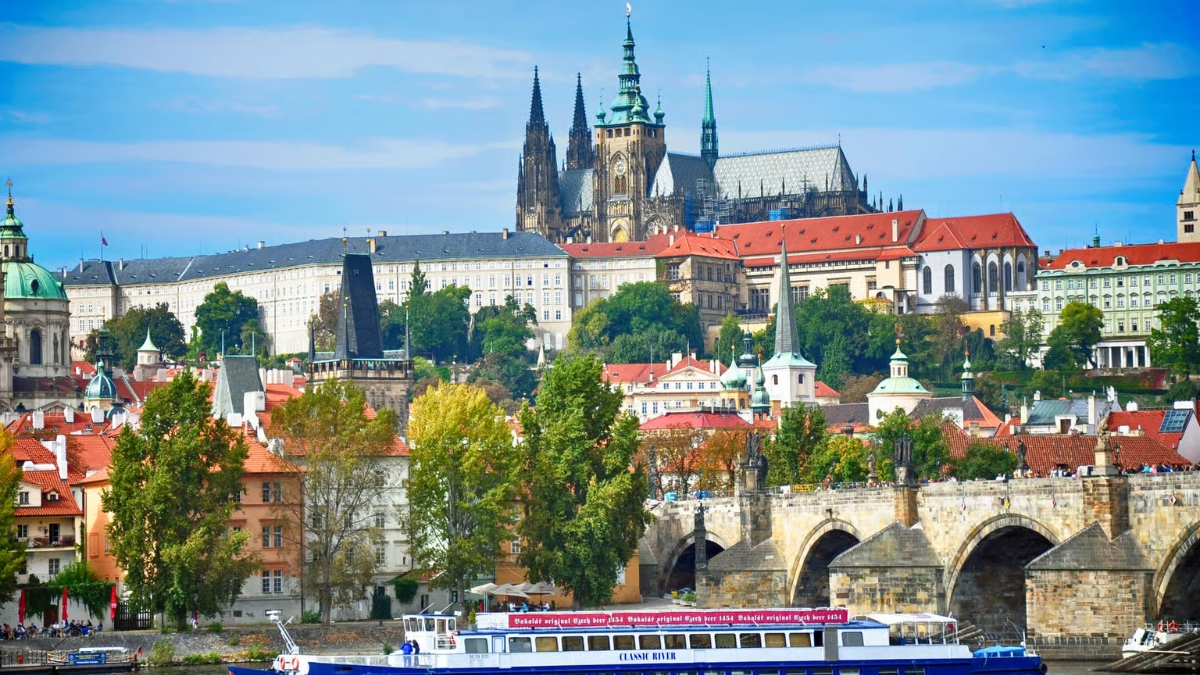
Prague Castle (Pražský hrad) is visible throughout most of a standard Vltava River cruise, dominating the left bank skyline from its position on the Hradčany ridge above Malá Strana. From the river, the full length of the castle complex — approximately 570 metres — is visible in a single panoramic view, including St. Vitus Cathedral’s spires, the palace buildings, the fortification walls, and the surrounding gardens. This comprehensive panorama cannot be seen from any street-level position in the city. It is the defining view of a Prague river cruise.
There is a moment on every Prague river cruise when the castle appears in full. You round a bend or clear the shadow of a bridge, and there it is — the entire Hradčany ridge, a half-kilometre of fortress, cathedral, palace, and gardens rising above the terracotta rooftops of Malá Strana on the opposite bank. From street level, this view is impossible. The castle is too large, too high, and too spread across the hillside to be seen as a coherent whole from anywhere on the ground. From the middle of the Vltava, it makes immediate sense.
What You See from the River
From the Vltava, the full length of the castle complex — approximately 570 metres — is visible in a single panoramic view: St. Vitus Cathedral’s Gothic spires rising above the roofline, the palace buildings stretching along the ridge, the Romanesque towers of St. George’s Basilica, and the fortification walls descending on both sides to the city below. The castle is visible throughout most of the cruise, from different angles as the boat moves north and south.
The view shifts as the boat moves. Approaching from the north on the standard sightseeing route, the castle appears first at a slight angle, the cathedral spires rising above the neoclassical buildings of Malá Strana below. As the boat moves south past Charles Bridge, the view opens to the full frontal panorama — the Hradčany ridge straight ahead, the complete castle sequence laid out from east to west. Continuing south past the bridge, the castle begins to recede and the left bank perspective shifts to the gardens and the southern fortification walls.
At night, the floodlighting illuminates the castle against the dark sky with a theatrical intensity that daylight never quite matches. The cathedral spires glow with a pale gold light; the palace rooflines are picked out in warm amber; and the entire Hradčany ridge is reflected in the dark surface of the Vltava below. The view from the River Vltava is one of a panorama of the coloured buildings of Malá Strana with the castle compound towering over it.
The Castle: Scale and History
Prague Castle is the largest ancient castle complex in the world by area — approximately 70,000 square metres (around 10 football fields) across the Hradčany ridge. Founded in the 870s by Prince Bořivoj, the first Christian ruler of Bohemia, it has been continuously occupied as a seat of power for over 1,100 years. Today it serves as the official residence of the President of the Czech Republic.
Prague Castle had its origins in the late 9th century, during the reign of Bořivoj, the first Christian prince of Bohemia. What began as a wooden fortified settlement on a hillside above the Vltava was progressively replaced, expanded, and rebuilt across eleven centuries of Bohemian, Habsburg, and Czech history. The result is one of the most architecturally layered sites in Central Europe — Romanesque foundations, Gothic cathedral, Renaissance additions, Baroque remodelling, and 20th-century modifications all coexisting within the same fortified perimeter.
Prague Castle’s architecture is a unique blend of styles from different periods, reflecting its long and complex history. The castle buildings represent many of the architectural styles of the last millennium.
St. Vitus Cathedral: The Dominant Silhouette
St. Vitus Cathedral (Katedrála svatého Víta) is the most visually prominent element of the castle complex from the river — its twin Gothic spires rise 97 metres above the castle courtyard and are visible throughout the Vltava cruise. The cathedral was begun in 1344 under King Charles IV and was not completed until 1929 — a construction period of nearly 600 years.
The spires visible from the river are the defining feature of the Prague skyline. In 1344, Charles IV began the construction of a Gothic cathedral. Its first builders, Matthias of Arras and later Peter Parler, built the chancel with a ring of chapels. The western half — including the famous rose window and the towers — is a 20th-century neo-Gothic addition, completed for the Wenceslas millenary celebrations in 1929. Despite this, the overall design is harmonious, and from the river the full height and mass of the cathedral reads as a coherent architectural statement rather than the patchwork its history might suggest.
The cathedral houses the Bohemian crown jewels, the tombs of Bohemian kings and Holy Roman Emperors, and the St. Wenceslas Chapel — one of the finest examples of Gothic decorative art in Central Europe.
The Changing Light: Day vs Evening
The castle looks dramatically different depending on the time of day. At noon in full sun, it presents a pale grey limestone facade with deep shadows in the windows and archways. In the late afternoon, the limestone catches the warm tones of the setting sun and the building shifts to amber. At night, the floodlighting creates a theatrical intensity that is arguably the most impressive version of the view — and the most photographed.
This variation in light is one of the reasons experienced Prague visitors return to the river at different times of day. The morning castle in soft spring light is quietly impressive. The afternoon castle in direct sun is photographically clear. The evening castle, illuminated against a darkening sky and reflected in the Vltava, is something else entirely — the version of Prague that visitors most frequently describe as having exceeded expectations.
For guidance on the best time to take a river cruise for this view, see Prague River Cruise: Day or Night? and Best Time of Year to Take a Prague River Cruise.
The Best Cruises for Castle Views
All standard Prague river cruises include views of Prague Castle — it is the dominant landmark on the left bank and impossible to miss on any Vltava route. But the best views come from:
Evening and night cruises, when the floodlighting is at full intensity: – Prague Sightseeing Dinner Cruise with Drinks — 3-hour glass boat, castle visible throughout – Vltava River Night Cruise with Buffet — 3-hour route passes the castle multiple times – Evening Sightseeing Prague River Cruise — 50 minutes, golden-hour timing
Longer routes, which keep the castle in view for more of the journey: – Vltava River Lunch Cruise — 2-hour route extending south to Vyšehrad – Prague City Highlights Vltava River Cruise — 75-minute panoramic cruise
Buy This TicketVisiting the Castle on Foot
For visitors who also want to explore the castle’s interior — and the interior is absolutely worth seeing — the castle is open daily, with tickets available at the gate or online in advance.
Opening hours: Castle complex daily 6:00–22:00; historical buildings 9:00–17:00 (summer), 9:00–16:00 (winter) Tickets: Basic Tour (St. Vitus Cathedral + Old Royal Palace + St. George’s Basilica + Golden Lane): 450 CZK adults, 300 CZK students/seniors Getting there: Tram 22 to Pražský hrad; or metro Line A (Malostranská) + uphill walk
Note: From March to July 2026, tram services to the Pražský hrad and Královský letohrádek stops are suspended due to track reconstruction. Use Pohořelec, Brusnice, or Prašný most stops instead.
Frequently Asked Questions
Can you see the whole Prague Castle from the river?
Yes — and the river is the only place in Prague where you can. The full 570-metre Hradčany ridge, including St. Vitus Cathedral’s spires, the palace buildings, and the fortification walls, is visible in a single panoramic view from the middle of the Vltava. From street level, the castle is too spread across the hillside to be seen in its entirety from any one point.
Is Prague Castle better seen by day or night from the river?
Both are impressive and serve different purposes. In daylight, the pale limestone architecture is rendered in full architectural detail. At night, the floodlighting creates a dramatic silhouette against the dark sky with the castle reflected in the Vltava. Most visitors describe the night view as more emotional and memorable. See Prague River Cruise: Day or Night? for the full comparison.
Which cruise gives the best view of Prague Castle?
Any cruise that passes the central Vltava stretch will have excellent castle views throughout the northern section. Longer cruises (2–3 hours) that also turn south toward Vyšehrad give multiple angles on the castle over time. Evening dinner cruises catch the most dramatic floodlit view.
How long does it take to visit Prague Castle?
Allow a minimum of 2 hours for the basic circuit (cathedral, old royal palace, golden lane). A thorough visit including all buildings and the gardens takes 3–4 hours. See the Practical Details section above for opening hours and ticket prices.
Is Prague Castle visible from Charles Bridge?
Yes. The castle is visible looking northwest from Charles Bridge — the Hradčany ridge rises above Malá Strana directly behind the bridge. However, only part of the castle is visible from the bridge; the full ridge is only apparent from the river.
