

The Devil’s Channel: Prague’s Hidden Waterway
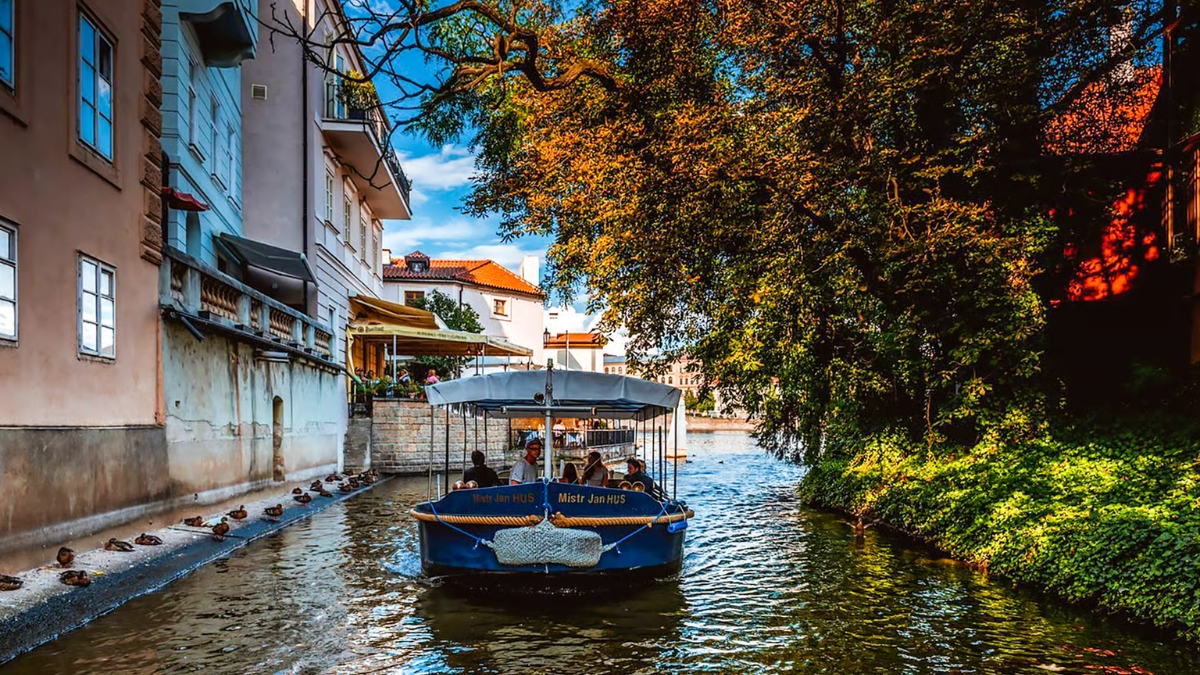
The Devil’s Channel (Čertovka) is a 740-metre man-made canal in Prague’s Malá Strana district, built in the 12th century by the Knights of Malta (Knights Hospitaller) to power mills along its course. It separates Kampa Island from the mainland of Malá Strana and is navigable only by small boats — larger Vltava vessels cannot access it. Three medieval mills survive along the channel; the most prominent is the Grand Priory Mill (Velkopřevorský mlýn), whose wooden wheel has been turning here since at least 1400. The channel takes its name from the 19th century, when local legend attributed it to a woman of “devilish character” who lived nearby.
Most visitors to Prague see the Devil’s Channel from Charles Bridge — the mill wheel visible below on the left bank side, turning slowly in the dark water, the medieval houses appearing to grow directly from the channel’s edge. Fewer see it from inside. The canal is one of the narrowest navigable waterways in Central Europe, and the only boats that fit through it are the small, purpose-built vessels operated by the canal cruise operators. Once inside, Prague changes completely.
History: Built by the Knights of Malta
The Čertovka canal was built in the 12th century by the Order of the Knights of Malta (formally the Knights Hospitaller), who were invited to Prague around 1156 by King Vladislav II after their service in the Second Crusade. The Order dug the canal to provide a regulated water flow for mills along its 740-metre course. Three of those mills survive to this day. The construction of the canal also created Kampa Island — the land between the canal and the Vltava that now forms one of Prague’s most distinctive neighbourhoods.
The Knights of Malta — properly the Sovereign Military Order of Malta, originally founded as the Knights Hospitaller — were invited to establish a Prague base by King Vladislav II, having seen their contribution to the Crusades. They founded the Church of Our Lady Beneath the Chain nearby, and had the canal dug to exploit the Vltava’s water flow for the mills they planned to build along its course.
The result was both practical and transformative. The canal created an artificial island — Kampa — on the western side of the Vltava, separated from Malá Strana by the narrow channel. Over the following centuries, mills, houses, and eventually gardens grew up along both banks of the canal, creating the picturesque waterway that exists today. The earliest mention of Kampa Island is from 1169, in the foundation charter of the Church of the Maltese Order.
The Name: Who Was the Devil?
The current name Čertovka — meaning “little devil” or “devil’s channel” — dates from the 19th century. The most popular legend holds that the name comes from a woman of notoriously quarrelsome character who lived nearby at Maltese Square (Maltézské náměstí); her difficult nature earned her the nickname “the devil,” and the channel near her house became known as the Devil’s Channel. Other theories attribute the name to the nearby house “U sedmi čertů” (At the Seven Devils) at Maltézské náměstí 14.
Before the 19th-century name took hold, the channel was known by several other names, including Strouha and Malostranská. The current name has stuck for over two centuries and suits the channel’s character perfectly — it is the kind of narrow, shadowy waterway that legend attaches to easily.
The Grand Priory Mill
The Grand Priory Mill (Velkopřevorský mlýn) is the best-known surviving mill on the Čertovka, with records of a mill on this site dating to at least 1400. The wooden water wheel visible today is a reconstruction, but it turns continuously and was still recognisable as a working mechanism when seen from Charles Bridge or from the canal boats passing beneath it. The mill building now serves commercial purposes.
The Grand Priory Mill takes its name from the Grand Priory of the Sovereign Military Order of Malta, whose headquarters are nearby in the Grand Priory Palace (Velkopřevorský palác). The mill was also known historically as the Maltese Mill and as Štěpánovský Mill, after a 16th-century miller named Štěpán. It is visible from Charles Bridge (on the left side heading toward Prague Castle) and is the landmark that most visitors notice first when looking down at the Čertovka.
The wheel does not grind grain — its function is purely decorative, a preserved reference to the channel’s original purpose. But the sound and sight of it turning in the narrow canal, with the medieval stone buildings rising on both sides, is one of the most memorable moments of any Prague canal boat tour.
What You See on the Canal
Inside the Čertovka, the scale drops from grand to intimate. Buildings that appear as ordinary Malá Strana facades from street level reveal their full waterfront height — several storeys of weathered stone and ancient render dropping directly to the water. The Grand Priory Mill wheel turns in the narrow channel; medieval houses appear to grow from the bank; and the sound of the water against stone creates an atmosphere unlike anything on the main Vltava.
The contrast between the open Vltava and the Čertovka is the defining experience of any canal boat tour. On the main river, the scale is panoramic — the castle above, the bridges spanning hundreds of metres, the embankment stretching in both directions. The moment the boat turns into the Čertovka entrance, everything contracts. The channel is narrow — in some sections barely wider than the boat — and the buildings on both sides close in immediately. Daylight diminishes. The mill wheel appears around a corner. The water reflects the ancient stone facades at close range.
Visitors who have previously walked Kampa Island often describe the canal experience as transformative — it is, genuinely, a different city than the one visible from the main river or from the streets above.
Prague Venice: Why the Nickname
The Čertovka is often called “Prague Venice” or “Prague’s Little Venice” by visitors and tourist operators, a reference to the way the medieval buildings grow directly from the canal’s edge. The comparison is imprecise — Venice is an island city built on a lagoon; Prague is a land city with a single navigable canal — but the visual quality that inspires it is genuine.
From inside the canal on a small boat, with buildings rising directly from the water on both sides and a narrow strip of sky visible overhead, the Čertovka does produce an atmosphere that recalls the feel of Venetian canals — intimate, enclosed, medieval, and distinctly separate from the world outside. For visitors who know Venice, the comparison is evocative rather than accurate. For those who do not, it captures something real about the character of the waterway.
How to See the Devil’s Channel
Two cruise options access the Čertovka:
Prague River Cruise to Devil’s Channel — A 45-minute small-boat tour on an electric vessel with a live guide. Departs from Čech Bridge (Pier 6), passes Prague Castle and Charles Bridge on the main Vltava, then enters the Čertovka. See Prague River Cruise to Devil’s Channel.
Prague Canal Cruise Around Charles Bridge — A 50-minute tour on a traditional wooden canal boat departing from directly beneath the Charles Bridge arches. Includes a drink, seasonal snack, audio guide in 19 languages, and Charles Bridge Museum entry. Also enters the Čertovka. See Prague Canal Cruise Around Charles Bridge.
On foot: The canal is also walkable from Kampa Island. Access via the stairs at the eastern end of Charles Bridge (Malá Strana side), then follow the water’s edge south along the island. The mill wheel is visible at close range from the footbridge over the canal near the Grand Priory Palace.
Frequently Asked Questions
How do you get into the Devil’s Channel on a boat?
Two cruise options access the Čertovka: the Prague River Cruise to Devil’s Channel (modern electric boat, live guide, departs from Čech Bridge) and the Prague Canal Cruise Around Charles Bridge (traditional wooden boat, departs from beneath Charles Bridge arches). Both enter the channel; standard Vltava sightseeing boats cannot fit through it.
Can you walk along the Devil’s Channel?
Yes. Access from Kampa Island: descend the stairs at the eastern end of Charles Bridge (Malá Strana side) and follow the water’s edge south along the island. The Grand Priory Mill wheel is visible from the footbridge over the canal near the Grand Priory Palace. No admission charge for walking the island or the canal path.
Is the mill wheel in the Devil’s Channel a real working mill?
The wooden wheel is a reconstruction that turns continuously but does not grind grain — it is a preserved reference to the canal’s original function. Three historic mill buildings survive along the channel, of which the Grand Priory Mill is the most prominent and visible.
Why is it called the Devil’s Channel?
The name dates from the 19th century and derives from a local legend about a woman of notably quarrelsome character who lived nearby at Maltese Square. Her difficult nature earned her the nickname “the devil,” and the channel became known by association.
How narrow is the Devil’s Channel?
In its narrowest sections, approximately 8–12 metres wide — barely wide enough for a small electric boat to navigate with metres of clearance on each side. This is what creates the intimate, enclosed atmosphere that distinguishes it from the open Vltava.
