

Charles Bridge: History & What to Expect
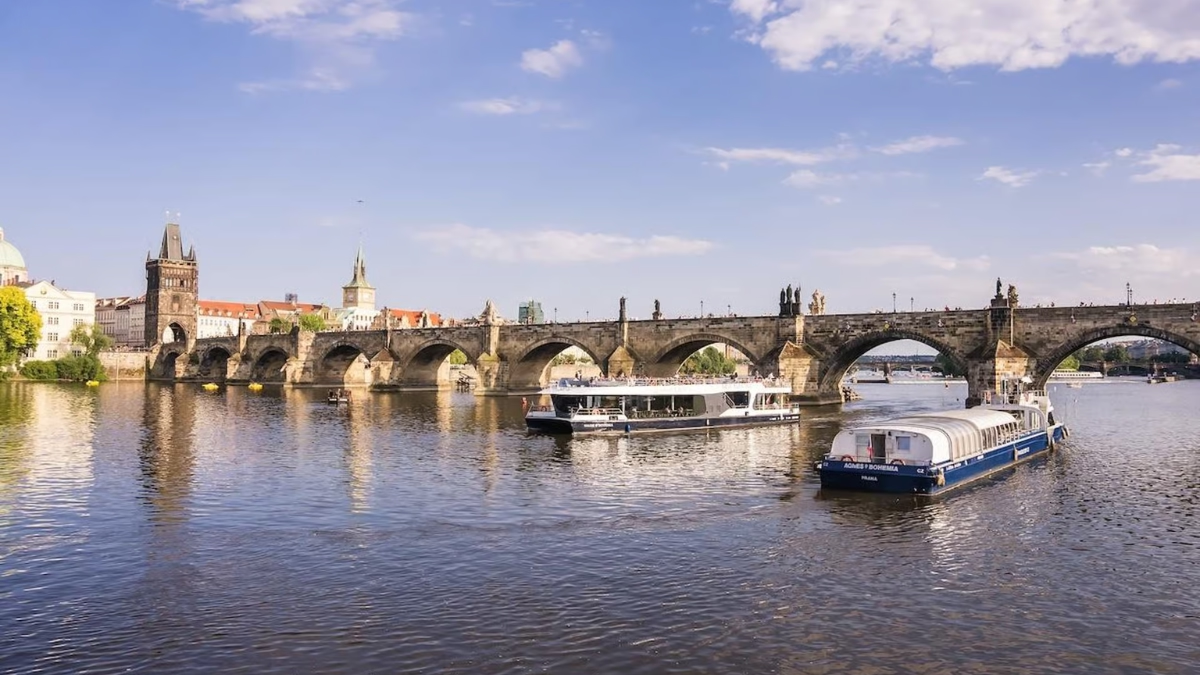
Charles Bridge (Karlův most) is a medieval stone arch bridge spanning the Vltava River in central Prague. Construction began on 9 July 1357 under King Charles IV and was completed in the early 15th century. It served as the only bridge over the Vltava in Prague for nearly 500 years. The bridge is 516 metres long, has 16 arches supported by 15 pillars, and is lined with 30 baroque statues of saints added in the 17th and 18th centuries. From the Vltava, the full length of the bridge, both Gothic towers, and the statues’ silhouettes are visible in a single view — a perspective impossible from street level.
Few bridges in Europe have the cumulative resonance of Charles Bridge. It was the most important trade route between Eastern and Western Europe for four centuries, the site of executions, battles, and processions, and the structure that effectively made Prague the central city of Central European history. It is also extraordinarily beautiful — and seen from the river, it appears in its full architectural integrity in a way that the crowds on its surface prevent from street level.
History and Construction
Charles Bridge was commissioned by King Charles IV in 1357 to replace the Judith Bridge, which had been severely damaged by a flood in 1342. Construction began on 9 July 1357 at 5:31 AM — a date and time chosen for its palindromic numerical symmetry (1-3-5-7-9-7-5-3-1), reflecting the king’s superstitious belief in numerical significance. The bridge was completed in the early 15th century and was the only crossing of the Vltava in Prague until 1841.
The architect was Petr Parléř, who also designed St. Vitus Cathedral at Prague Castle. The bridge is built from sandstone blocks and rests on 15 pillars, with 16 arches spanning the full 516-metre width of the Vltava. The stone arch is a Roman engineering invention that Charles Bridge uses to extraordinary effect — the bridge has survived centuries of flooding, wars, and traffic that would have destroyed a lesser structure.
Its importance to trade cannot be overstated. As the only Vltava crossing for nearly five centuries, it was the fulcrum of Central European commerce — everything moving between east and west passed over it. The tolls collected at its towers funded much of medieval Prague.
The Baroque Statues
The 30 baroque statues lining Charles Bridge were added progressively between 1683 and 1714, following the Counter-Reformation programme of the Habsburg rulers. Each statue represents a Catholic saint endorsed by the Church, intended as a devotional series for pilgrims crossing to Prague Castle. The most famous is the gilded statue of St. John of Nepomuk, who was thrown from the bridge into the Vltava in 1393 on the orders of King Wenceslas IV.
The statues are a unique characteristic of Charles Bridge among European medieval bridges. Rather than a decorative afterthought, they were part of a deliberate religious-political programme: the Habsburgs, having defeated the Protestant Bohemians at the Battle of White Mountain (1620), used the bridge’s statuary to assert Catholic dominance over the city’s most visible public space.
St. John of Nepomuk stands above the spot where he was thrown into the river. According to legend, five stars appeared on the water where his body fell. He was canonised in 1729, and touching the brass plaque on his statue pedestal is said to bring good luck — a tradition that has polished the plaque to a high sheen. The statues lining the bridge from the Old Town side include St. Vitus, St. Francis Xavier, Saints Cyril and Methodius, and the Pietà group.
Most of the statues visible today are 20th-century copies; the originals were moved to the National Museum to protect them from weathering and pollution.
The Two Towers
Charles Bridge is flanked by two Gothic bridge towers, one at each end. The Old Town Bridge Tower (Staroměstská mostecká věž) is widely considered one of the finest Gothic secular buildings in Central Europe. The Malá Strana towers are slightly different in height and style — one short Romanesque tower (surviving from the earlier Judith Bridge) and one taller Gothic tower added later.
The Old Town Bridge Tower served a defensive purpose and was the site of one of Prague’s most historically significant events: on 21 June 1621, 27 leaders of the Protestant anti-Habsburg revolt were executed on the Old Town Square, and their severed heads were displayed on the tower for years as a deterrent. Today visitors can climb the tower for one of the best views in the city.
From the River: Why the Bridge Is Different Seen from Below
From a Prague river cruise, Charles Bridge appears in full — the entire 516-metre length, both towers, and all 30 statues — in a single panoramic view that is simply impossible from street level. When passing beneath the arches, passengers look up through the stone spans to the bridge deck above. This is the view that defines the waterborne Prague experience.
The effect of passing under Charles Bridge is difficult to adequately describe in advance. The bridge deck is pedestrian-only and crowded at most hours; from the deck, the view is of the city extending in both directions. From the water, the relationship is reversed: you see the full mass of the medieval bridge from below, the individual arches passing overhead, the towers visible at each end, and the statues’ silhouettes along the parapet. The transition from open river to beneath the arches and back to open river takes approximately 30 seconds — long enough to take a photograph and short enough to wish it lasted longer.
At night, the tower floodlighting and the ambient illumination of the bridge create a reflection in the Vltava that is among the most photographed views in Europe. Evening cruise passengers consistently cite this moment as the highlight of the experience.
Buy This TicketVisiting Charles Bridge on Foot
For visitors who also want to walk the bridge — which is worthwhile regardless of the river view — a few practical points:
The bridge is open 24 hours and free to cross. Early morning (before 7:00 AM) is the most peaceful time — in midsummer the bridge is crowded from 9:00 AM onward. The towers have separate admission charges and are worth climbing for the views. The Charles Bridge Museum at the Old Town end offers admission separate from the cruise ticket (though the Canal Cruise Around Charles Bridge includes museum entry in its ticket price).
See Prague Canal Cruise Around Charles Bridge for the cruise that includes both the canal experience and museum entry.
Frequently Asked Questions
When was Charles Bridge built?
Construction began on 9 July 1357 under King Charles IV and was completed in the early 15th century. The foundation stone was laid at 5:31 AM — a time and date chosen for its palindromic numerical significance (1-3-5-7-9-7-5-3-1).
How many statues are on Charles Bridge?
30 baroque statues, added progressively between 1683 and 1714 as part of a Counter-Reformation devotional programme. Most of the statues visible today are 20th-century copies; the originals are in the National Museum to protect them from weathering.
Is Charles Bridge free to walk across?
Yes. The bridge is pedestrian-only, open 24 hours, and free to cross. The towers at each end have separate admission charges. Early morning (before 7:00 AM) is the best time to walk it without crowds.
What is the best view of Charles Bridge?
From the Vltava River, from below the arches. From the river, you see the full 516-metre length, both Gothic towers, and the statues silhouetted along the parapet — all in a single view. From street level, you can only see the bridge from one end or from the sides. See the full section above for the river cruise perspective.
Can the Prague Canal Cruise take you under Charles Bridge?
Yes — and it is one of the defining moments of the canal cruise experience. The boat passes directly beneath the arches of Charles Bridge before entering the Čertovka canal. See Prague Canal Cruise Around Charles Bridge for full details.
