

Bridges of the Vltava: A Complete Guide
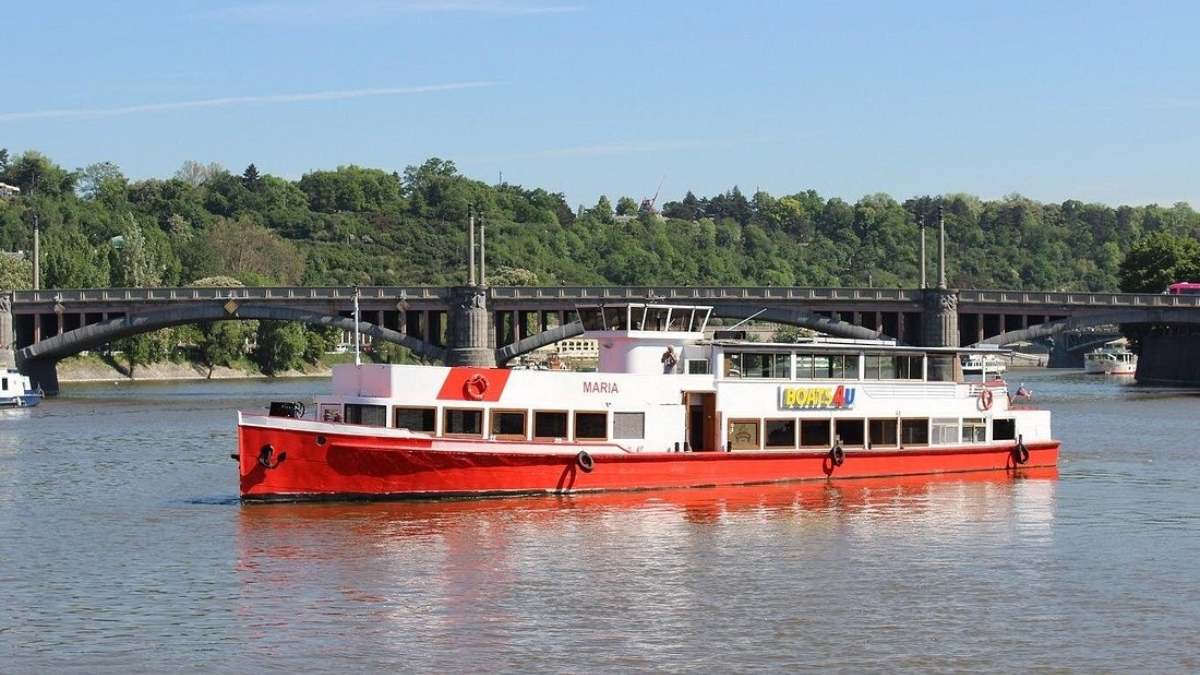
There are 18 bridges over the Vltava River within Prague, spanning architectural periods from the 14th-century Gothic of Charles Bridge to the 2014 Troja Bridge. A standard 50–75 minute sightseeing cruise passes 5–6 bridges; longer routes pass up to 8. The most architecturally significant bridges on the standard cruise route are Charles Bridge (1357–1402, Gothic), Čech Bridge (1905–08, Art Nouveau), Legion Bridge (1899–1901, Neo-Baroque and Art Nouveau), Mánes Bridge (1914), and Jiráskův Bridge (1933). From 1158 to 1841, Charles Bridge was the only river crossing in Prague.
Prague is a city of bridges. There are 18 crossing the Vltava within the city limits — Gothic, Baroque, Art Nouveau, functionalist, modernist, and brutalist, each built in a different era and each telling a different chapter of the city’s architectural history. A river cruise passes through them all in the central section of the city, and understanding what you are looking at as each bridge approaches makes the experience significantly richer.
The Bridge Timeline: Six Centuries of Crossings
From 1158 until 1841, Charles Bridge was the only bridge over the Vltava in Prague — a span of nearly 700 years. The second bridge, Emperor Franz I Chain Bridge, was built in 1841, since replaced by the current Legion Bridge. The 18 bridges existing today were all built between 1357 and 2014 — 657 years of bridging history compressed into a single river crossing.
The history of Prague’s bridges is effectively the history of the city’s expansion and modernisation. For seven centuries, one bridge held the city together. Then, in the second half of the 19th century, industrialisation and population growth forced a rapid programme of new crossings — four new bridges were built between 1841 and 1901 alone. The 20th century added more, and the most recent addition, the Troja Bridge, opened in 2014.
The Bridges on the Standard Cruise Route
Charles Bridge (Karlův most) — 1357–1402
The oldest and most celebrated bridge in Prague, built in Gothic style by Petr Parléř under King Charles IV. It served as the only Vltava crossing in Prague for nearly 500 years and is lined with 30 baroque statues of saints added between 1683 and 1714. Every river cruise passes beneath its arches.
The view of Charles Bridge from the water — the full 516-metre length, both towers, and the statues silhouetted along the parapet — is impossible to replicate from street level and is one of the defining moments of any Vltava cruise. At night, the towers are dramatically floodlit and the statues cast shadows across the lit stone of the parapet. For the full history, see Charles Bridge: History & What to Expect.
Čech Bridge (Čechův most) — 1905–08
The Čech Bridge (named after Czech writer Svatopluk Čech) is Prague’s only Art Nouveau bridge and its shortest main arch crossing at 169 metres. Built entirely of iron with lavish Art Nouveau decoration, it features four bronze sculptures of winged figures on tall columns at each end, ornate iron lampposts, and intricate relief detailing along the balustrades. It is widely considered Prague’s most beautiful bridge after Charles Bridge.
The contrast between Čech Bridge and Charles Bridge — separated by only 600 years of architectural history — is one of the most visually arresting juxtapositions on the cruise route. Where Charles Bridge is massive, stone, and Gothic, the Čech Bridge is light, iron, and ornamental — all flowing lines and gilded bronze in the Art Nouveau style. Most cruise boats depart from piers close to this bridge, so passengers see it at very close range both on departure and return.
Legion Bridge (Most Legií) — 1899–1901
The Legion Bridge connects the National Theatre embankment on the right bank with Újezd in Malá Strana. Built in a combination of Neo-Baroque and Art Nouveau styles, it is 345 metres long with nine oval arches and features two toll booth structures at each end. A staircase at its centre descends to Střelecký Island, a green island in the middle of the Vltava used since the Middle Ages as an archery range.
The Legion Bridge provides one of the best river views in Prague: from the centre of the bridge, the entire panorama of Malá Strana and Prague Castle is visible to the west, and the National Theatre to the east. On the river cruise, the bridge appears in the southern section of the central city route and marks the transition from the historic embankment to the more modern southern stretch.
Mánes Bridge (Mánesův most) — 1914
The Mánes Bridge, named after 19th-century Czech painter Josef Mánes, joins the Old Town embankment near the Rudolfinum with Klárov in Malá Strana. Its relatively simple design — clean lines, modest ornamentation — reflects the transition from Art Nouveau to the early modernist aesthetic of the pre-World War I period. Photographer’s favourite: the bridge provides the best framing of Charles Bridge from a downstream position.
From the river, the Mánes Bridge appears just north of Charles Bridge and provides one of the most technically satisfying views of the older bridge — the two towers and the full arch sequence visible in one frame. The Mánes Gallery, a modernist art venue built over the river adjacent to the bridge, is also visible as an unusual structure that appears to grow from the water.
Jiráskův Bridge (Jiráskovo nábřeží) — 1933
Built in a functional modernist style, the Jiráskův Bridge connects the New Town embankment near the Dancing House with Smíchov on the left bank. Its design was deliberately restrained — and reportedly designed with hollow pillars that could be filled with explosives if defensive demolition was ever required (subsequently blocked with concrete during the Nazi occupation). Despite its utilitarian character, it is among the most photographed bridges in Prague due to its proximity to the Dancing House.
The Jiráskův Bridge appears in the southern section of most cruise routes, immediately near the Dancing House on the right bank. The two landmarks together — the 1933 functionalist bridge and the 1996 deconstructivist building — form one of the more distinctive architectural pairings on the entire cruise route.
Buy This TicketOther Notable Bridges on the Vltava
Palacký Bridge (Palackého most) — 1876–78
The third oldest functioning bridge in Prague, the Palacký Bridge is a stone and cast-iron structure notable for four groups of allegorical sculptures representing Czech legendary figures — including pairs representing Czech mythological characters. It marks the southern edge of the central city cruise route on longer departure schedules.
Negrelli Viaduct — 1846–50
The oldest surviving bridge structure on the Vltava, the Negrelli Viaduct is a railway bridge of 87 stone arches, 1,100 metres long and 7.6 metres wide. Built to connect the Olomouc-Prague-Dresden railway line, it was designed by Austrian engineer Alois Negrelli, co-designer of the Suez Canal. It appears at the northern end of the cruise route and is visible from boats approaching or departing from the Čech Bridge pier area.
Štefánikův Bridge — 1951
A postwar bridge in functionalist-socialist style, the Štefánikův Bridge is the departure point landmark for many cruise operators — Pier 17 and Pier 18 sit immediately adjacent to it. Most passengers walk across or alongside this bridge to reach their boat.
What Makes Each Bridge Distinctive
| Bridge | Year | Style | Notable Feature |
|---|---|---|---|
| Charles Bridge | 1357–1402 | Gothic | 30 baroque statues, two towers, the oldest bridge |
| Čech Bridge | 1905–08 | Art Nouveau | Iron arches, bronze sculptures, shortest main bridge |
| Negrelli Viaduct | 1846–50 | Industrial | 87 stone arches, railway viaduct, oldest structure |
| Legion Bridge | 1899–1901 | Neo-Baroque/Art Nouveau | Nine oval arches, access to Střelecký Island |
| Mánes Bridge | 1914 | Early Modernist | Best upstream view of Charles Bridge |
| Jiráskův Bridge | 1933 | Functionalist | Proximity to Dancing House; was designed for demolition |
| Palacký Bridge | 1876–78 | Historical/Stone | Allegorical Czech legend sculptures |
| Troja Bridge | 2014 | Contemporary | Steel arch design, newest bridge, tram and pedestrian access |
Bridges and the River Cruise
From a river cruise, the bridges are experienced sequentially as the boat moves north or south — each one framing a different section of the city. The Gothic towers of Charles Bridge visible from the open Vltava. The ornate iron lampposts of Čech Bridge at the departure pier. The simple modernist span of Jiráskův Bridge beside the curved glass of the Dancing House. The bridges are a structural record of Prague’s architectural history, compressed into a single navigable corridor.
For the full overview of landmarks visible from the river, see Landmarks You'll See on a Prague River Cruise.
Frequently Asked Questions
How many bridges cross the Vltava River in Prague?
18 bridges, spanning architectural periods from the 14th-century Gothic of Charles Bridge to the 2014 Troja Bridge.
Which Prague bridge is the oldest?
Charles Bridge, built between 1357 and the early 15th century. Before it, the Judith Bridge (built 1158, destroyed by flooding in 1342) occupied a nearby crossing. The Negrelli Viaduct (1846–50) is the oldest surviving bridge structure that still stands, though it is a railway viaduct rather than a pedestrian or road crossing.
Does a Prague river cruise pass under all the bridges?
A standard 50–75 minute cruise passes 5–6 of the central city bridges. Longer routes (2–3 hours) pass 8 or more. The full count of 18 bridges includes those in the northern and southern outer districts not covered by standard cruise routes.
Which Prague bridge is the most architecturally distinctive after Charles Bridge?
The Čech Bridge (1905–08) is widely considered the second most beautiful bridge in Prague — an Art Nouveau iron structure with ornate bronze sculptures and lampposts, the only Art Nouveau bridge in the city. It is also one of the first landmarks seen on departure from the Čech Bridge cruise piers.
Can you walk across all 18 Prague bridges?
Most bridges are accessible on foot or by bicycle. Charles Bridge is pedestrian-only; the Negrelli Viaduct is railway-only. The remainder are generally open to foot traffic with varying footpath arrangements.
